For years, artists have had questions about how streaming income actually works. Since 2021, we’ve published Loud & Clear to give you clear answers with real data. This site shows you what artists are earning, how payments flow, and where the music economy is headed. We’re the only streaming service sharing data at this level – because we believe transparency helps everyone make better decisions.
Your Questions,
Answered
We’re sure you have a ton of questions about the economics of music streaming, and we want to make sure you get the answers. Below, we’ve answered the top questions we hear most frequently from artists, and we’ll continue to add to this list as more come in.
Quick Search Filters
What’s new on Loud & Clear this year?
On March 11, 2026, we updated Loud & Clear with:
- 2025 royalty data across the entire site
- A new set of Top 10 Takeaways to summarize our key findings from the data
- A new Homepage to help you better navigate all of our Loud & Clear resources
Wasn’t the music industry better off before streaming?
The music industry is healthier now than it’s been in decades, and streaming is a big reason why. Think of Spotify as a radio station and record store combined, but without the limitations of either.
With radio, artists can reach lots of listeners. However, there’s limited space in a radio station’s rotation of songs, making it harder for artists to break through. And in some markets, artists are not compensated when their music is played.
Artists benefit from a high purchase price in record stores, but physical and digital sales generate revenue only at the moment of purchase, a one-time transaction from fans willing to buy a track or album. That means they don’t capture income from every fan who listens, and they don’t create ongoing revenue when fans return to a song months or years later. And again, there is the issue of limited space. Not all artists are able to have their CDs or vinyl on a shelf in a physical record store.
Streaming solves both problems. Your superfans can listen on repeat, while casual listeners discover your music for the first time, and every listen generates revenue. Instead of relying on a single purchase during an album’s initial release window, artists can earn recurring income for years as fans return to their music over time. Both types of listening generate revenue for you, from fans who pay for Spotify Premium, and from advertisers that fund Spotify’s Free tier. (We have more than 290M Premium subscribers, and more than 60% of first-time subscribers start out on the Free tier and then later upgrade.)
When Spotify launched in 2008, piracy had cut the global music industry nearly in half, from a $24B peak in 1999 down to $13B by 2014.
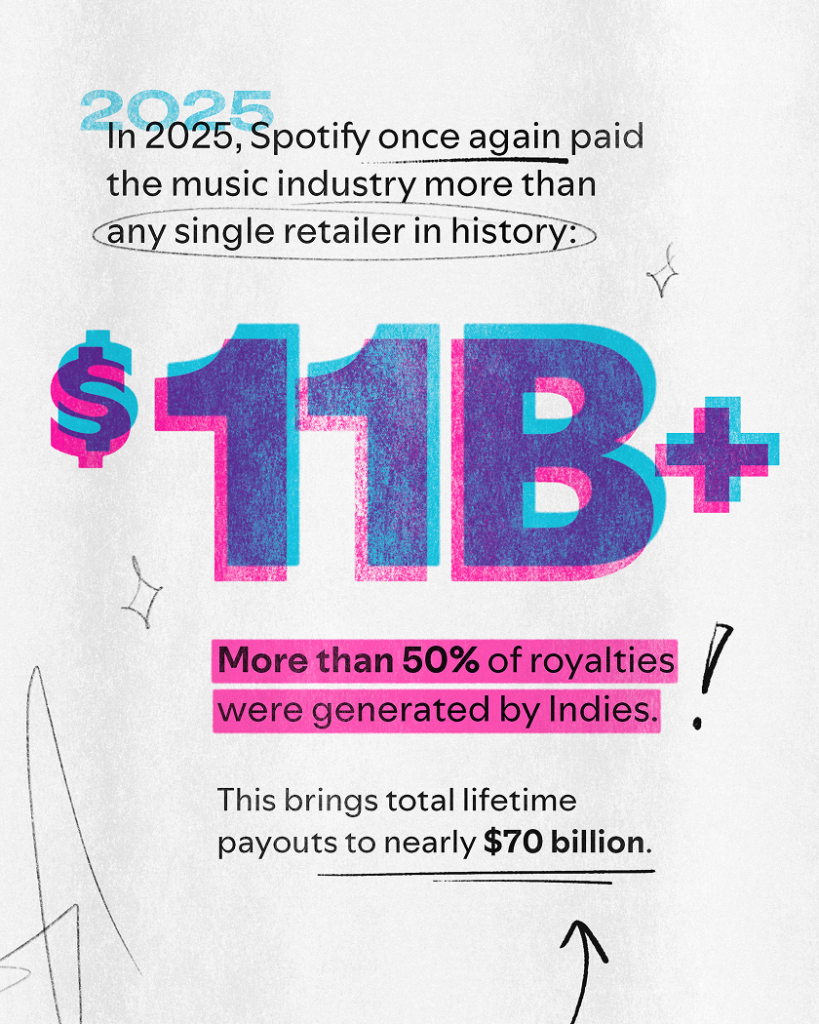
Since then, streaming has powered the resurgence of the music industry. Spotify’s all-time payouts to music rights holders now stand at nearly $70 billion.
Today, the industry has bounced back to $31.7B (IFPI), well past that 1999 peak. And more artists are succeeding now than ever before.* The royalty pool keeps growing, and so does the number of artists building sustainable careers from their music.
*All statements on this website attributable to IFPI represent Spotify’s interpretation of data, research opinion, or viewpoints published as part of the IFPI Global Music Report in March 2026 and have not been reviewed by IFPI. Each IFPI publication speaks as of its original publication date and not as of the date of this report (March 11, 2026).
Is streaming only helping music’s biggest stars?
No. Streaming has actually made the music economy less top-heavy. In the CD era, the top 50 artists captured 25% of all U.S. sales. Today, they account for only 12% of streams on Spotify. That means more money is flowing to more artists than ever before, including independent artists and labels, which collectively generated about 50% of Spotify royalties in 2025.
In 2025, over 81,000 artists earned at least $10,000 from Spotify alone. Even more telling: The 10,000th-ranked artist on Spotify went from earning $34K in 2017 to $147K in 2025, more than 4x growth.
Here’s what some might find surprising: More than 80% of artists generating $1M+ on Spotify in 2025 did not have a Top-50 hit. You don’t need a chart-topper to build a million-dollar career.
Streaming has fundamentally changed the music ecosystem, lowering barriers to entry for artists of all levels and democratizing access to audio for listeners across the world. Artists no longer need to be superstars with access to big budgets or powerful gatekeepers to create, distribute, and amplify their music globally.
Is it just artists in a handful of markets who are benefiting?
Streaming has lowered barriers to entry for artists around the world, and the growing impact on artists’ livelihoods worldwide is becoming clearer over time. Artists are succeeding globally, in more languages than ever before.
Artists who would have struggled to break through before are now finding their audiences and building careers, no matter where they’re from or what language they sing in. The music industry today is a more diverse and accurate reflection of the world we live in.
There are millions of artist profiles on Spotify, yet only a small fraction are generating money. Shouldn’t a higher percentage of all artists on Spotify be making money?
Here’s the reality: Not everyone releasing music on Spotify is trying to build a music career. Success looks different for everyone, and we’re focused on creating real opportunities for artists who are pursuing this professionally.
About 13 million people have uploaded at least one song to Spotify. But just like posting a video to YouTube doesn’t make you a professional YouTuber, uploading a song doesn’t mean you’re pursuing a music career. Of those 13 million, nearly 8 million have released fewer than 10 songs total, and around half of all those uploading music to Spotify in 2025 were uploading music for the first time. Many are hobbyists, just starting out, or aren’t focused on streaming as a career path.
So how many artists are actually pursuing this professionally? We estimate around 250,000 globally. Here’s how we calculate that: 1. About 288,000 artists have released 10+ songs (a real body of work) and average 10,000+ monthly listeners (an engaged audience). 2. Looking at our integrations with Bandsintown, Ticketmaster, and other ticketing partners, we see 218,000 artists listed at least one live or virtual event in 2025, showing they’re actively working beyond streaming. That data suggests a population of between 218,000 and 288,000 artists. To account for a margin of error in our methodology, we consider 250,000 to be a reasonable estimate, though of course we acknowledge the difficulty in assuming any artist’s professional intent just from data.
Looking at it with this metric in mind, more than 30% of professional or aspiring professional artists earned $10K+ from Spotify alone in 2025. Across all recording income sources, that’s likely $30K+.
I heard Spotify pays a fraction of a penny per stream. Is that true?
Here’s the thing: Streaming doesn’t work like buying songs. Fans pay for unlimited access, not per track they listen to. So a “per stream” rate isn’t actually how anyone gets paid – not on Spotify, or on any major streaming service. Instead, you get paid based on your share of total streams — which is called “streamshare.”
Our focus is simple: maximize the total money flowing to artists and songwriters. The data on this site shows that progress. In 2025 we paid out $11B+, more than any other streaming service, and more than any year in our history. That figure has increased by more than 10x since 2014 and represents a big part of the nearly $70B Spotify has paid since its founding.
Our incentives are aligned with artists: Like all major streaming services, we pay out roughly two-thirds of every dollar generated from music back to artists’ and songwriters’ rights holders. So that means that when we grow, artist payouts grow, too.
Our model drives more fan engagement and generates revenue from more places, which means larger total checks from Spotify to rightsholders. That’s why we pay more than any other service, and probably why many other services keep their total payouts to the industry a secret. We are maximizing overall revenue and generating the most possible money for rightsholders and their artists and songwriters.
We know that “per-stream rate” can seem like an intuitive calculation to make, and you may want help making sense of the per-stream comparisons across streaming services that you see discussed publicly. We break down why those numbers look the way they do in the question below: “Why does the per-stream rate appear lower for Spotify than some other streaming services?“
If an artist has millions of streams, why don’t they earn more?
Spotify’s been around for more than 15 years, and we’ve grown to 751M+ listeners who stream more music per month than ever. As the platform grows, so does the total number of streams.
Remember: Everyone gets paid based on streamshare, not per stream. So yes, as total streams grow, you need more streams to maintain the same share. But here’s what matters: The total royalty pool is growing, too. In 2025, capturing one in every million streams on Spotify equals, on average, $11,000.
Because of the growth of streaming and the increase in engagement per user, the meaning of “a million streams” has changed over the years. Lots of tracks are reaching a million streams, and more often than you’d think. In fact, 1,580,000 songs have now surpassed a million streams, and 400,000 songs received a million streams in 2025 alone. That’s up from 281,000 songs in 2022. 1,200 songs reached a billion streams by the end of 2025. To get a better sense of the Spotify ecosystem, you can play around with the interactive tool on this site, which reflects data as of December 2025.
Why does the “per-stream rate” appear lower for Spotify than some other streaming services?
The reality is simple: No service pays a fixed amount per stream because listeners don’t pay per stream either; they pay for access and can stream as much or little as they want. All streaming services pay essentially the same way: Around two-thirds of music revenue is paid back to rights holders based on their streamshare.
If every service pays out the same way, why is the average payout per stream different for each service?
The calculation is simple: Total payouts ÷ total streams = the “per-stream rate.”
So if users of a service don’t stream very much, the “per-stream rate” is higher. But the problem is that streaming more means people like the product and will continue to pay for music (and drive streams and money to a wider array of artists). If you stream very little, you are less likely to continue being a Premium subscriber, which means less money for artists.
Spotify offers the most engaging service where users stream more each month. The average Spotify listener streams 3 to 4 times more music per month than the average listener of other streaming services.
A service where fans listen only occasionally will generate fewer streams, a smaller royalty pool, and less total income for artists, no matter how the “rate” is framed. A service where fans listen daily, discover new music, and stay engaged is best at acquiring and retaining paying subscribers and growing the royalty pool for everyone.
The most active music listeners are on Spotify, and that engagement is what drives the economics of streaming.That’s why Spotify has the highest total payouts by far: $11B+ in 2025, up 10x from 2014. Everyone in the industry should want more streams per user as opposed to less.
Building a service that inspires listeners to stream lots and lots of music each month decreases the effective “per-stream rate” on Spotify but increases total payouts. We believe a larger paycheck is more important to artists than a higher “per-stream rate.”
You can dive deeper into the truth about streaming payouts here.
How do you know Spotify listeners stream more music than listeners on other services, and why does that matter?
The average Spotify listener streams 3 to 4 times more music per month than the average listener of other streaming services.
We learn this from third-party industry data: Spotify drives ~70% of total on-demand audio streams (Luminate 2025, ex-China) even though just ~40% of global streaming users are on Spotify (MIDiA, ex-China). Put differently: If Spotify’s 40% of listeners in the world that stream music account for 70% of all streams — and everyone else’s 60% of listeners only account for the remaining 30% — that tells us that the average Spotify listener streams about 3 to 4x more music per month than the average listener on other services.
The most active music listeners are on Spotify, and that engagement is what drives the economics of streaming. Today, an average Spotify subscriber listens to more than 200 different artists a month, and nearly half of those are artists they’re discovering for the first time, which is an amazing thing for the music industry. This fact — that Spotify users listen to and discover more music — is a really key driver of bigger payouts for artists, but it also drives a major misconception.
You’ve probably heard people compare “per-stream rates” across services. But the reality is simple: No service pays a fixed amount per stream — because listeners don’t pay per stream either, they pay for access. Any “rate” is calculated afterward by dividing total payouts by total streams. Since subscription services are similarly priced, the biggest driver of a so-called “per-stream rate” is how much fans actually stream. If a service has really big music fans who stream 3-4 times more music per month, that’s great for growing royalties, but makes the “per-stream rate” appear lower.
If a service is bragging about a high “per-stream rate,” they’re actually just telling you their average user doesn’t stream very much music. A service where fans listen only occasionally will generate fewer streams, a smaller royalty pool, and less total income for artists — no matter how the “rate” is framed. A service where fans listen daily, discover new music, and stay engaged is best at acquiring and retaining paying subscribers and growing the royalty pool for everyone.
How do artists and songwriters get paid?
We don’t pay artists or songwriters directly, we pay rights holders, who then pay you based on your agreement with them.
Here’s how it works: Spotify makes money from Premium subscriptions and advertising on the Free tier. About two-thirds of that money goes into the royalty pool.
We divide that pool based on streamshare. You get paid based on your percentage of total streams, not a fixed rate per stream since listeners don’t pay per stream. They pay a subscription for unlimited access.
To put that in real terms: In 2025, an artist who captured one in a million of all Spotify streams generated about $11,000.
For more info, we encourage you to check out the following videos: How the Money Flows, and How the Money Flows (Publishing Edition).
How does Spotify help artists earn beyond streaming royalties?
Streaming royalties are the foundation, but we’re building tools to help you monetize in other ways, too. Discovery on Spotify can lead to:
- More concert tickets sold (through our Bandsintown, Ticketmaster, and other ticketing integrations)
- Merch sales (promoted directly on artist profiles)
- Brand partnerships and sync deals (built on the audience data artists access through Spotify for Artists)
When you build your fanbase on Spotify, you’re building an engine for your entire career.
Why doesn’t Spotify just charge listeners more?
We helped shift listeners from piracy to paid subscriptions, but pricing must strike a delicate balance. A subscription has to be financially manageable; otherwise we risk pushing listeners back to piracy or free alternatives that don’t pay artists anything.
Actually, music fans today spend nearly 2x more than they did during the 1999 CD peak, and millions more people are paying for music now than then.
We regularly evaluate pricing in every market to keep up with changing conditions. Since Spotify and rights holders share the same pool of money, our incentives are totally aligned: We both want to generate as much revenue from listeners and advertisers as possible.
Should the numbers you’re presenting around artists’ revenues be much higher?
We want to be clear and upfront about what these numbers show: Spotify royalties only. Our focus is on growing that total payout to artists and songwriters. Both our own and third-party data shows that growth is indisputable.
This growth is accelerating. Artists earning $100K+ per year have more than tripled since 2017.
Spotify is powering careers at every level:
- 81,000+ artists earned $10K+ in 2025 (up 3x from 2017)
- 13,800 earned $100K+ (up 3x from 2017)
- Over 1,500 earned $1M+ (up 3x from 2017)
Remember: Spotify accounts for about 30% of global recorded music revenue. So an artist earning $10K on Spotify likely made around $30K total from all recording sources that year.
These numbers also don’t include touring, merch, brand deals, or other income. Here’s what’s important: the audience you build on Spotify can fuel all of those other revenue streams. Discovery on Spotify is often the foundation for a full career.
You shared that an artist’s Spotify royalties can be multiplied by three to estimate total music revenue. Is that really true?
The data on this site shows Spotify earnings only. Want to estimate total income? Here are three ways to think about it:
All Streaming (3x): Spotify accounts for about a third of global streaming revenue. So $100K from Spotify likely means $300K from all streaming services combined. (This varies by genre, fanbase, and marketing, but 3x is a solid average.)
All Recording Revenue (3x): Spotify accounts for about 30% of global recorded music revenue. That includes streaming, physical sales (CDs, vinyl), sync, performance rights, and downloads. So $100K from Spotify likely means $300K from all recording sources. (Again, this varies by artist, but 3x is a good benchmark.)
Total Career Income: These numbers don’t include touring, merch, brand deals, sync placements, or other income beyond recordings. Those revenue streams stack on top, and for many artists, they’re where the real money is.
How is streamshare calculated?
Every month, in every country, we calculate streamshare like this: your streams in that market ÷ total streams in that market = your share of that market’s royalty pool.
For example, if your music is 0.1% of all streams in Mexico, you get 0.1% of Mexico’s royalty pool. The total royalty pool in each market is based on the subscription and music advertising revenues generated there.
At the global level, capturing one in a million of all Spotify streams in 2025 generated about $11,000 (compared to $1,000 in 2014).
Would the user-centric model be fairer?
We’re open to switching to a user-centric model if that’s what the industry wants. But we can’t make this change alone. It requires alignment across labels, publishers, distributors, and other streaming services.
The research suggests user-centric payments wouldn’t help most artists as much as people hope. A study from France’s National Music Centre found it would result in “at most a few euros per year on average” for artists outside the top 10,000. That research can be viewed here, and a useful summary of that research can be viewed here.
How is Spotify measuring payouts on this site? Why not focus on what artists and songwriters actually take home?
We can only report what we can see: the total royalties generated on Spotify. We’d love to show you what artists actually take home, but we don’t have visibility into everyone’s individual contracts with their labels, publishers, or distributors.
So this site shows total royalties generated, both recording and publishing, for each artist’s full catalog per year.
Spotify doesn’t pay artists or songwriters directly. We pay rights holders selected by the artist or songwriter, whether that’s a record label, publisher, independent distributor, performance rights organization, or collecting society. From here, we encourage you to check out the following videos: How the Money Flows, and How the Money Flows (Publishing Edition).
How can I grow my audience and find success on Spotify?
We’re building Spotify to help you grow your fanbase at every stage of your career. More than 1 million artists use Spotify for Artists every month, and we keep building new tools to help. You can explore Spotify for Artists features here.
If you’re looking for specific tips when it comes to releasing new music, we’ve put together this New Releases Guide to help.
How much money does Spotify keep?
Like every major streaming service, Spotify pays out roughly two-thirds of music revenue to rights holders. As Spotify revenues grow, payouts to the music industry grow as well.
What about the remaining third? That’s been our fuel to reinvest directly into the platform in ways that drive more people to pay for music streaming and continue to grow revenues for music. By continuing to innovate on behalf of the industry, we’ve been able to build a listening experience that attracts and retains hundreds of millions of fans, expanding the royalty pool year after year.
How can I put streaming numbers in context for my home market?
The Streaming Numbers in Context section of the site focuses on global figures for the sake of simplicity, but one useful indicator for how local stream counts stack up is to check out your local Spotify Chart. You’ll find that the number of streams it takes to chart in different territories around the world can vary quite a bit. For example, what it takes to chart in Malaysia and Bulgaria can look pretty different from Australia and Mexico. Also, through Spotify for Artists, artists can view the geographic breakdown of their listeners (by city and by country) in the Audience tab of their dashboards.
Why don’t songs with fewer than 1,000 annual streams earn recording royalties on Spotify anymore?
Under our royalty policy, tracks need at least 1,000 streams in the past year to generate recording royalties. This doesn’t change the total royalty pool or increase Spotify’s profit; it redirects money to professional artists.
99.5% of all streams are of tracks that have at least 1,000 annual streams, and each of those tracks earn more under this policy.
In 2025, 3.5 million artists had at least one qualifying song. Average recording royalties earned per monetized song has more than tripled from 2023 to 2025.
Here’s how it breaks down: Tens of millions of tracks would only earn only $0.02 per month on average. Together, these sub-1,000-stream tracks represent about 0.5% of streams (and would therefore earn 0.5% of the royalty pool without our policy). With an $11B+ annual pool, 0.5% is real money, tens of millions of dollars per year.
Here’s the thing: Payments under $2 often don’t even reach artists. Labels and distributors have minimum withdrawal amounts ($2-$50), and banks charge transaction fees ($1-$20). So these tiny payments frequently get stuck in the system rather than reaching anyone’s pocket.
So, we redirect that money to where it can make a real difference: to artists who are actually building careers on streaming.
What impact does artificial streaming have on Spotify royalties?
Spotify’s policy is that when we detect any artificial streams, those streams do not earn royalties.
We invest heavily in detecting, preventing, and removing the royalty impact of artificial streams. We want to ensure that artificial streams have no benefit and do not create any second-order negative impact on legitimate streams.
In some cases with artificially streamed tracks, you may still see streaming spikes in your private Spotify for Artists data, even though associated royalties have been withheld and public metrics (all-time track stream counts and monthly listener count) have been adjusted. In other cases, we can detect and remove confirmed artificial streams before they reach your Spotify for Artists dashboard, which means you might be informed by your distributor of artificial streaming activity, even though the streams aren’t visible in your Spotify for Artists. Either way, the royalty report from your label or distributor is the most accurate source of truth for understanding royalties generated from Spotify streams.
You can read more about artificial streaming here.
The Takeaways
What stood out in the 2025 royalty data.
1
The $11B+ Growth Engine
2

The New Global Class of $100K Artists
3

Million Dollar Careers
4

The Rising 100,000th Artist
5

From Fresh Finds to Six Figures
6

The DIY Path to an Enduring Career
7

50%+ Comes From Abroad